The World Encompassed
Derek Wilson, Hamish Hamilton, 1977. Paperback, Alison Busby, 1998
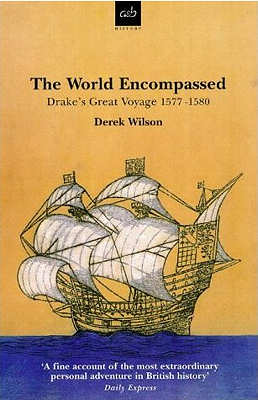
The World Encompassed
Derek Wilson's enthralling book takes us into a world of political intrigue, danger, treachery, courage and determination. With the author, we shall embark upon a voyage into the unknown, on a 120 ton sailing ship to, "plough a furrow about the globe." We shall sail on one of the greatest voyages in maritime history, under a commander who has had very few equals. Derek Wilson's absorbing and masterly book, The World Encompassed narrates and analyses the events of the first English circumnavigation of the world. Wilson's style enables you to feel the wind on your face, hear the voices of Drake and his men, and see the Golden Hind turning her prow ever westwards.
The World Encompassed was published in hardback twenty-one years ago. Hence, its coming-of-age, seems an appropriate time for a paperback re-issue of an excellent book that, deserves and will appeal to a wider audience than maritime historians.
The World Encompassed is one of a number of books that concentrate on one aspect of Drake's life. This book contains a summary of Drake's life and achievements, but specifically deals with the circumnavigation. Wilson provides an objective account and has used a judicious mixture of both primary and secondary sources to present a fair and balanced account of the voyage.
The book is intended for an academic and general readership, resulting in an interesting style of writing, combining imaginative prose with academic text, quotations and footnotes. It is beautifully illustrated with maps and photographs and some very striking line drawings based upon contemporary manuscripts.
I find The World Encompassed both interesting and useful for five reasons. Firstly, it is well-written and informative. Secondly, Derek Wilson challenges the reader on a more academic level. He poses a variety of open-ended questions, presents the evidence and leaves the readers to form their conclusions. Thirdly, he demonstrates his theory that, we can best understand Drake's complex personality by examining his reaction to the events of the voyage; to which, Wilson presents an interesting analysis. However, I do not agree with some of Wilson's descriptions about Drake's character. Nonetheless, I find Wilson's theories stimulating and thought provoking. Fourthly, the book produces a sound analysis of Drake's activities at Cape Horn and furnishes a potent argument for the Cape being a Drake discovery. Finally, Derek Wilson assesses both the short-term and long-term effects of the circumnavigation and sets the voyage in its historical context.
A review by Michael Turner
By coincidence, after Susan had written her review, Derek Wilson's publishers contacted the Society requesting us to review the paperback. I considered it an excuse for closer study.
Derek Wilson is as eloquent verbally on television as he is as a writer. He is highly competent at interpreting complex sources and relates a story so well that, it is easy for the reader to mentally accompany Sir Francis through his world adventures, with a great sense of empathy. However, I have two complaints. The text should have been updated to reflect our changing world; for example, the phrase political correctness had not been coined. Sugden had updated his paperback, which appeared only five years later. Wilson could have taken advantage of the latest research and been far more accurate with his topography. Sugden's revised preface indicated how Wilson could have updated his research.
In Chapter 1, I enjoyed setting sail with Drake but had to endure the flash backs of Drake's career and an appreciation of the political scene in chapters 2 and 3 before leaving Plymouth for a second time. Hence, once Drake had spread the canvas, I would have liked to have been on an uninterrupted voyage: not partly expecting such an interruption.
p.26. To state that Drake had few genuine friends and was difficult to love, is a controversial assessment as Drake the man, which many of our members, through objective thinking, will find hard to accept.
p.27. To write that Drake was attended by a Negro slave, is incorrect and unhelpful in projecting Drake, in the light that he deserves, in an age of political correctness. Diego voluntarily served Drake, whom he had met at Nombre de Dios.
New research by Sugden and Jackson proves that, Drake's father left Tavistock to rehabilitate himself from criminal charges . This departure had nothing, or little to do with the Catholic rebellion.
Recent authors contradict Wilson's claim that Drake's childhood had been spent in embarrassing poverty.
p.31. Dedicating himself to a career of piracy is incorrect. This is too crude. A pirate would attack ships of all nationalities. Drake was involved in a religious and privateering war and acted within the laws of his country. Drake's later voyages were more overtly and heavily supported by the Crown, which makes Wilson's statement even more unacceptable.
p.32. To write that whilst in Panama, Drake and his men suffered periods of inadequate food is an over dramatisation. Drake was frequently intercepting Spanish ships and had created a network of storehouses in the San Blas Islands.
Wilson's reference to Thomson p.78 is the wrong page!
I am baffled as to why Wilson writes that the cimarrones, agreed to lead the Englishmen to a hidden hoard of gold and silver stolen from the Spaniards... because Wilson does not follow this up: probably because it was not true!
p.36. ...the queen did not want to upset her brother King Philip. Is this a true statement and was Philip her brother?
p.37. Why refer to John Hawkins as Sir in 1577 when he was knighted in 1588?
p.45. We now know that the Golden Hind was built in Plymouth. This is another reason why the text should have been modified.
p.51. The map wrongly gives the impression that Drake did not anchor inside Cape Blanco in Mauritania. .The inset repeats this error of Drake not anchoring at Maio.
p.60. Praia was not the capital nor the main anchorage of the Cape Verdes; it was Santiago. This was Portugal's first colonial city. This is why Drake began raiding the island at Santiago in 1585.
p.61. Drake and his men are called pirates.
p.66. The map incorrectly depicts Drake at Port Desire [Puerto Deseado] Argentina. Drake was in Nodales Bay to the south.
St Julian's Bay should always be called Port St Julian.
p.73. Drake did not anchor in Montevideo Bay. He would have been embayed by the southerly wind; also the water is rather shallow. [Raymond Aker of The Drake Navigators' Guild] The offshore island was Isla Flores. It seems that Wilson was influenced by Wagner's error.
p.76-7. Cape Blanco is not a wooded headland. ...welcome liquid notes of a stream falling through the tangle of vegetation ahead. This is Wilson at his poetic best. Consequently, the armchair critics are impressed. Furthermore, evocative descriptions are what publishers seek. However you would not be impressed if you went to Cape Blanco because there is no water supply. The poetry exceeds the topographical accuracy. Therefore, how much else is untrue? Yes, I am being pedantic to the armchair reader but not to anybody wishing to visit Drake's world.
p.78. Drake did not enter Port Desire. [Puerto Deseado] This was discovered by Cavendish. Two of our members have visited St Julian. If they had wanted to study the story at Port Desire, they would have wasted their time and money. The geography at Nodales Bay fully accords with The World Encompassed and Fletcher's Notes.
The Patagonian giants were seen before arriving at Port Desire.
p.87. There is no rocky island in the middle of Port St Julian. The islands are of shifting pebbles.
p.97. The Strait of Magellan is the proper name. Straits implies plural. Wilson's description of the entrance is dramatic and totally fabricated. The landscape is very flat. Da Silva could have told the author this much.
The penguins were taken from Magdalena Island and not from Elizabeth Island. Wilson omits that Drake's first act of overseas possession was on Elizabeth Island. The island still bears this name.
p.103. Wilson is non-committal over Drake discovering Cape Horn. He could have been the first author to capitalise on Raymond Aker's work.
p.109. Wilson implies that Guatulco is in Nicaragua but it is in Mexico.
p.118. Drake anchored inside La Herradura Cove and not outside. Coquimbo had been warned of the pending arrival of pirates. There is a high neck of land between Coquimbo and La Herradura, form where, there is a commanding view. Drake had unwittingly anchored within three miles of the town!
p.131. The capture of the Cacafuego was the greatest coup of Drake's piratical career. Cacafuego does not mean spitfire. You need to replace the "p" with an "h".
p.132 and 146. The pirates.
p.144. Drake did not careen beyond Caño Island but adjacent to it. "beyond" is a vague word.
p.149. Only from the pen of a later contemporary writer do we read of Drake being intimate with Maria. Drake would have maintained the respect of his men by not indulging. He would not wish for Doughty's brother to inform his wife. Secondary authors need to take a more cautious approach.
p.153. The map omits the first landfall at the River Sesto in Liberia.
p.225. If the author had visited coastal California in summer, he would have believed the contemporary descriptions of the cold and foggy weather.
p.155. To enter Drakes Bay, the helm would be put over to starboard and not larboard.
A reprint would have given Wilson the chance to assert that Drake was in Drakes Bay and Estero. [The Americans have omitted the apostrophe]
p.164. Here the book is embarrassingly out-of-date. It has been proven that the brass plate was a clever hoax.
p.181. The poetic prowess detracts from fact. There are no breakers on the Vessuvius Reef, upon which Drake ran aground. This is because the water suddenly shoals, since the walls of the reef are, as The World Encompassed states are near vertical.
p.184 note 4 on p. 229. If Ray Aker also took the view that it was worthless trying to establish where Drake was due to: vague latitudes; the changes in place names or their absence, he would have never reconstructed Drake's route through the Far East!
p.184. Yes it was Damar Island. However, the canoes were seen at this island and not on another. Hence, Drake visited two places on Damar and not one.
p.186. Collecting turtles on Rusa Island has been omitted. I would have thought that the few books which specialise on one voyage, could have included all the anchorages. Others anchorages have been omitted.
Yes Drake was at Tjilatjap. It is now spelt Cilacap but pronounced "Chilachap."
It is wrong to write that this was the last foreign harbour for the Golden Hind. Drake was to anchor at present-day Freetown.
p.189. We have never read that there was a Portuguese spy at Cilacap.
p.206. A big mistake here. It was Sussex who did not like Drake: not his good friend Arundel who left Drake a gold ring in his will. [Susan Jackson]
I really valued Wilson's book for giving the most detailed account of Drake's movements before and after the voyage.
Writers ought to have their work proof read by other "experts," if they did, then the entire readership would be impressed throughout the book. Consequently, this review proves that, an adventure novel - and every word of it true is far-fetched! However, for £9.99 this book represents fantastic educational value.
