Sir John Hawkins, Queen Elizabeth's Slave Trader
Harry Kelsey, Yale University Press, London, 2003
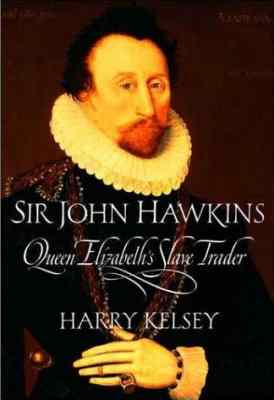
Sir John Hawkins, Queen Elizabeth's Slave Trader
John Thrower inspired me to read this book, since Kelsey stated that John Hawkins lived in "Myncing Lane". Mincing Lane is a modern street in the City of London about 300 metres WNW from the Tower of London. I realised that because Drake and Hawkins lives were often inextricably linked, some of Hawkins' haunts, such as Deptford, would have been visited by Drake. Kelsey writes that John's older brother was buried in Deptford Church. Drake may have visited the tomb since he bought Plymouth property from William soon after returning from the world voyage. We read that in the autumn of 1593, Prize Commissioner Drake was in Plymouth meeting royal officials auditing the spoils from the Madre de Dios. This Portuguese carrack had been captured by the Earl of Cumberland and inventorized in Dartmouth. There is a Hawkins memorial in the Church of St Dunstan-in-the-East; should there be one for Sir Francis in St Andrew's Church, Plymouth?
Our first record of Drake sailing on a John Hawkins voyage is with John Lovell in 1566. Kelsey writes that Drake could have sailed with John Hawkins on two earlier voyages in 1562 and 1564-65. This is based upon contemporary commentator Edmund Howes who wrote that Drake first sailed to Guinea aged twenty. Kelsey is probably correct to state that Drake was born in 1540, although dates vary from 1539 to 1542. However we do not know if Howes knew the date of Drake's nativity. Also a sailing date of 1562 is when Drake, by Kelsey's reckoning,was twenty-two years old. Drake is supposed to have sailed as far as Sierra Leone and to have returned in a ship full of goods from Tenerife and West Africa.
On Hawkins' second slaving voyage of 1564-65, Kelsey strongly suggests Drake was aboard. The stops that are unique to this voyage are at El Ferrol, Spain and Angla de Santa Ana, south of Cape Blanco in Mauritania (a place that is new to me). However the Hakluyt account names it "S. Avis Baye", which is within Cape Blanco. There was an attack on a village called Bymba in Sierra Leone. The account in Hakluyt proves that Kelsey omits several sojourns in the New World, such as Cumaná in Venezuela and a nearby watering place "two leagues off" at Santa Fé in Venezuela. I was in Cumaná in 1984 and knew of Hawkins's anchoring. Then Kelsey includes all the following places that are unique to this Hawkins voyage, Isla de Pinos and Cabo San Antonio in Cuba. There is the visit to Fort Caroline on the St John River in Florida, which he also includes in his Drake biography. Interestingly Hawkins provisions with cod on the Newfoundland Banks in Canada. Of curious interest is the fleet docking at Padstow in Cornwall. On the final Hawkins voyage, Kelsey geographically misplaces at least three stories. He has the unsuccessful enticement of blacks at Cabo Rojo in Guinea-Bissau, when the Cotton Narrative clearly states the location to be eight leagues to the north. He mistakes the Bijagos Islands in Guinea-Bissau with the Los Islands of Guinea and has the fatally injured black warrior, later in the voyage, running along the riverbank in Sierra Leone instead of in Guinea-Bissau. Kelsey asks us right at the beginning to forgive his unavoidable errors. The author treats Hawkins as kindly as possible and states that he was a more successful seaman than Drake. This begs a definition of successful. The jacket notes continue with an admission that Hawkins committed adultery but I did not find any reference to this in the book.
