Sir Francis Drake The Queen's Pirate
Harry Kelsey, Yale University Press London, 1998
Sir Francis Drake The Queen's Pirate
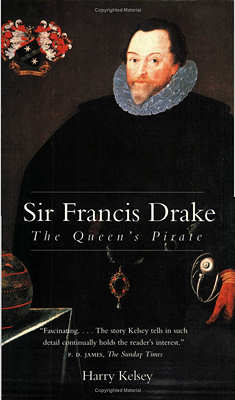
The best thing about this book is the dust jacket. Refreshingly, it bears a hitherto unused contemporary portrait of a mature looking Sir Francis. What expenses have been saved by not including the usual crop of photographed portraits, contemporary maps and artefacts, have been wisely diverted to copious computer generated maps. However, in places the contemporary maps are more accurate than the author's. The book portrays Drake's character and achievements negatively. The jacket notes imply that this is why the book was written and published. Upon reading, I deduce that Kelsey predetermined to attack Drake's character because he lambastes Drake over incidents that have escaped all minds of the objective scholars. For instance, Kelsey implies that Drake should have relinquished the attempt to become rich in Panama, once he had lost two brothers. Drake was blamed for deserting the dying Le Tetu who was shot in the stomach with no chance of recovery. Drake and Le Tetu had only met days before the mule train robbery to form their temporary alliance. In those days, men signed on for ventures realising the high risks of death and did not expect camaraderie comforts in the survival of the fittest. Kelsey is naive to apply 20th century values to the evolving moral behaviour of the 16th century. Some of Kelsey's criticism verges on the absurd. For example, once the ships remained separated after exiting the Strait of Magellan, he implies that Drake would have been pleased to rid himself of the troublemakers. Logically, Drake knew that he could obtain fewer riches with just one ship. If he had not lost the crews of the Elizabeth and the Marigold he would have captured more towns, such as Arica.
Kelsey does not realise that Drake discovered Cape Horn. He tries to make a case that Drake did not anchor in California, USA. One could write a book correcting Kelsey.
Drake is human. However, his harsher qualities are sharpened beyond reason. In the desperate situations in which Drake finds himself, during his extraordinary escapades that contribute towards his legendary status, Kelsey's character interpretation is brutal. His negative approach fails to applaud Drake for his unique achievements and to realise that certain characteristics are necessary to lead men into unexplored realms. Kelsey has little sympathy with the fact that all Elizabethans during this hitherto, unprecedented period of maritime expansion, were finding their "sea legs" amid an immature system. Therefore, the open-minded, Drake scholar, will buy the book wondering if (s)he has to re-assess the hero of their school years. My objective thinking was hardly stirred.
Furthermore, the Drakeophile will always be intrigued to learn of yet more uncovered archival sources that authors conveniently transport to their armchair. Kelsey was financed to study in many of the world's archives and has indeed, published some new primary sources. Disappointingly, these have not included the hitherto unseen Portuguese sources for Ternate and the Cape Verde Islands. The references are extensive but perhaps a little too profuse. Since the references are included in virtually every paragraph, it is annoying to oscillate constantly from the story to the back of the book. Footnotes would be an improvement if the book is subsequently published in paperback. Kelsey has shown a competent grasp of the Spanish language. However, the seasoned Drake reader will not learn much from this book.
Kelsey's geographical interpretation falls well short of his research skills as a historian. Kelsey has not tried very hard to identify the "Drake places". When he has tried, he is often wrong since his assertions are based upon flimsy sources, such as Geografía y descripción. Kelsey has revealed hitherto, unpublished descriptions of Drake's movements. However, some errors are so clumsy, that one wonders just how much of this and the remainder of the book are true. To add to the uncertainty, the reviews by P D James in the Sunday Times and Felipe Fernández-Armesto in the Independent cannot be based upon thorough reading of the book. Studying Kelsey's end of chapter character summaries may be all that was in fact read.
Corrections & Comments for a Possible Paperback Edition
The geographical corrections are based upon my Drake fieldwork around the world.
p19. You need to identify the location of Fort Caroline. Despite your wide use of maps, we are at a loss to know even in which country it was situated.
p32. Drake was not sailing up a river in Sierra Leone to reinforce an attack. This was beforehand in the River Cacheu in Guinea-Bissau. This is a clumsy misunderstanding of the primary accounts. Hence, unfortunately, the Cacheu skirmish has been omitted.Hawkins and Drake did not sail east to the Guinea coast but south.
p40. "The trip from San Juan de Ulua to the southeast coast of England..." should read south-west.
p46. Venta de Cruces and Venta de Chagres were not situated along the same trail. The Camino Real and the Cruces Trail were two different roads.
p48. Drake's alleged letter was written off Pontón and not off Cape Cativa. Again, you have geographically misplaced your information. Pontón is clearly mentioned in the Spanish dispatches.
p50. Rio de Piñas is not Drake's Port Pheasant: it is the wrong shape. The land is not high enough. Do visit Zapzurro Cove just inside Colombia. See Sugden footnote, p52.
p53. Nombre de Dios did not become active in the rainy season. The Camino Real was impassable for the treasure trains. The flotilla did not arrive until the end of the rainy season - late January. Drake had attacked at the wrong time of year due to insufficient information. Do remember that these were Drake's salad days.
You do not locate the River Francisco yet you write that it was about 2 leagues from the Cativas. However, it is 8 leagues. Hence, not 6 miles but 24. What an error!
p55. Harry, believe me the story about the proposed artillery platform is true. A sculptured hill does lie to the east of the site of the colonial town. I found the broken cannon that did brake when fired against Drake in 1595.
p62. The horseman along the Camino Real was not an outrider but was riding towards the pack train from the other direction.
p94. Cape Agadir should be Ghir or Rhir. Since this cape is 25 miles north of the town it would not be called Agadir.
p97. On the contrary Harry, a landing was made on Brava. The hermit's house is clearly described. It still stands! In places your analysis of the primary accounts is a shambles. Anybody buying your book as a guide to visiting the Drake sites, would be wasting a lot of money!
p100. Cape Santa María is not Drake's Cape Joy. It is too shallow, rocky and exposed. The cape is at Piriapolis.
p102. Drake's Cape Hope is present-day Cape Blanco: not Cape Tres Puntas. This also represents an 8 mile error. Do remember that when Drake landed at this cape, he had anchored a league offshore. Drake only anchored so far from shore about six times in his life. He did so here because of the presence of Bryon Bank. There are no such shallows out at sea off Cape Tres Puntas.
p103. You have made the usual common error. Drake next anchored at Nodales Bay and not at Deseado. The hill that runs from east to west upon which the Indians danced is on the north shore of Nodales. If your royalties are sufficient you should visit these places or buy my photographic slides.
p140. Quintero was not the port for Santiago. There has never been a port settlement here. Valparaíso was the port. Valparaíso was not a small harbour but still remains a large bay. Rather it was a small town. Drake did not overshoot the town due to a crew suffering from wounds. If so, he would not have returned within a day or so.
p148. There is no island protecting the indentation of the coast at Tarapaca. Ruined houses still stand!
p150. Chule was not west of Arequipa but SSW. I am the only person to have identified it from fieldwork. Your book lacks this aspect of research. Your re-print ought to call upon my body of work.
p155. The description of Los Quijimes is an absolute red herring! The ship of Benito Díaz Bravo was not anchored here, so why mention rivers? Rather the ship was sailing out at sea near Los Quijimes. See Wright 146. How could you misread this?
p163. Drake did not careen on the Island of Caño, rather in the adjacent bight on the mainland that is now called Drake's Bay. The settlement is called Drake.
p165. It is ridiculous to think that Drake was thinking about careening in Acapulco. This was an important Spanish port like Callao. He wanted seclusion and security from attack: not a Spanish shipyard! Harry, there are no volcanoes in Honduras!
p183. You are wrong to dismiss the Nova Albion insert as fictitious or representing Acapulco. You need to accept that the careenage at Cilacap Indonesia is also accurately depicted. [p203] From my travels all the inserts match the geography. You could at least visit Drake's Cove inside Point Reyes California, since you live close enough.
You exhibit a sense of ill-founded superiority when other Drake readers are described as fans or enthusiasts. In my unfinished manuscripts, I call them scholars. We are more than enthusiasts. We are serious lifelong students of Sir Francis.
p196. Harry, the accounts do not suggest any landing in the "Islands of Thieves." In the circumstances this would not have been wise.
The Portuguese ship did not take refuge in a bay, since there is no bay in the open sea, 19 miles NNW of Sangi Island. The ship escaped Drake by sailing along a narrow passage over the Louisa Bank.
p197. Your map needs an arrow to show that Drake sailed between the Sarangani Islands.
P.216 In 1580 Drake buys a house in Elbow lane, London. This is welcome new research.
p246. Cies Island should be Islands.
p248. "It did not bother him in the least to deprive someone, friend or foe, of life or property." If Drake was such a tyrant, I have always wondered why Tom Moone was such a dedicated follower: 1573 until his death in 1586.
p251. The map carelessly depicts the ships passing on the north side of: Mayo, Santiago, Fogo and Brava. They passed on the south side. See the Boazio Voyage Map.
p253. You omit Drake's second landing on Hierro. Hence, he did not wait idly for the missing ships.
p256. Santo Domingo should be Santo Domingos. The accounts clearly state this and so do the residents today. You give the impression that after leaving Santiago town, Drake stopped en route at Praia. This is not true because Drake backtracked east by ten miles.
p258. You correctly narrate Drake's visit to the Cayman Islands. However, your map on this page depicts the fleet passing 170 miles to the west! A scale on your maps would be an improvement.
p259. There is no surf at Haina.
p263. Why omit the anchorage at Cape Vela? This was where the new Hope was ballasted and where Drake dispersed his troops into boats.
p264. Your Spanish is good enough for you to understand that Boca Grande means Big Mouth. This entrance is not small: it is a mile wide! Please be specific and not misleading.
p271. The Spanish witness, genuinely meant not very cruel. You over-step your limits of credibility to suggest that this was an add-on sarcastic comment. You will now have learned that there are more than "fans" and "enthusiasts" reading your book. We have also studied the primary sources!
p276. Since maps are a speciality of your book, why omit Charleston Harbour where a spruce tree was felled to replace a mast?
p277. In your debate whether or not the fleet reached Plymouth or Portsmouth in 1586. You have failed to mention that the Boazio Voyage Map clearly shows the fleet entering Portsmouth. All Boazio's maps are very accurate.
p284. Hawkins was not Sir in 1586.
p295. You mislead us again. Troops were not landed in Lagos harbour but 3 miles west at Praia de la Luz, meaning Beach of Light.
p310. It is a misnomer to imply that those sailors defending the realm against the Spanish Armada were pirates. You state elsewhere, "Elizabeth and her pirates..." This is a disparaging way to write English history. Other authors write, "the queen's commanders..." Corsair and privateer are words that are unfortunately not in your vocabulary. You have over-used the word pirate throughout the book. Drake was not a pirate, since he always acted within the queen's law. She only called him, "My little pirate" to show support for his nationalistic actions and not to substantiate the definition. Surprisingly, you have not quoted this topical description. You need to explore subtleties.
p316. Another careless error. The primary sources clearly state that the explosion on the Revenge occurred in Portsmouth.
p348. Some of your earls have small e's others begin with a capital E.
p374. The first 10 pages of "The Last Voyage" chapter need to be in a chapter of another name, since these pages have nothing to do with the title.
p387. Bahía San Germán is not on the SW tip of Puerto Rico. As usual, you have been selective in your use of sources and slavishly copied. Another source correctly states that it was the westernmost tip. The SW corner is dry and devoid of rivers. I have seen the first map drawn of the west coast of Puerto Rico and have extensively photographed the area.
p389. There were two recorded times of Drake's death. Hence, again you are very selective with your sources. The reader will be cheated of more knowledge.
p393. Oddly enough and within the tone of your book, you have omitted Mendoza's description of Drake as being "the master thief of the unknown world."
"Somewhat cold...personal relations" cannot be applied to why Drake had no children. This is unfair and is another one of your absurd deductions. Author Sidney Wignall plausibly suggests that Drake was infertile. It must be obvious to you that Drake would prefer to leave his estates to his children rather than those of his brother. Do not let your crusade of negative assessment blind the truth.
p394. Drake could never be in command during the Armada battle, since protocol required the admiral to be from the gentry. Hence, Drake was given the highest command possible.
My observations are designed to be helpful. I hope that you will now rendezvous with moderation, balance and truth.
